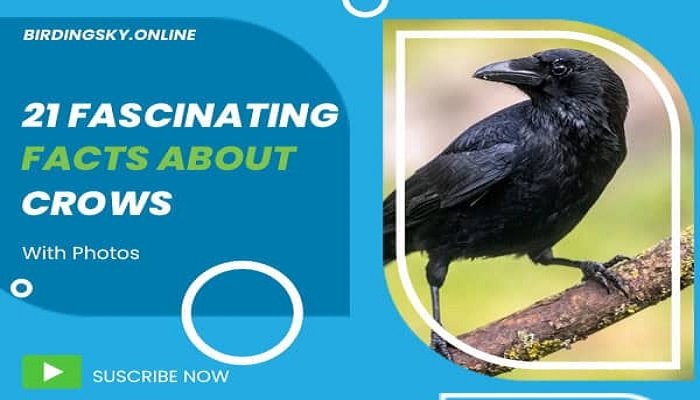
21 Fascinating Facts About Crows sever wondered about their smarts? I’ve researched these black-feathered geniuses and found they’re not just brainy; they’re ingenious. They craft tools, recognize faces, and hold funerals. Their social life? Complex. Their memory? Incredible. Join me in uncovering the secrets of crows, where every fact is a surprise. Let’s dive into their world together.
Main Points:
- Crows are highly intelligent birds known for their problem-solving skills.
- They have complex communication methods and can recognize human faces.
- Crows exhibit playful behavior and have been observed using tools.
- They are adaptable when it comes to their diet, feeding on a wide range of foods.
- Crows are found in various habitats across the globe.
Crow Behavior and Communication
Crows are not just highly intelligent birds, they also exhibit a complex set of behaviors and communication methods that allow them to interact with each other and even with humans. Understanding their behavior and how they communicate can give us fascinating insights into their social dynamics and cognitive abilities.
Behavior with Humans
When it comes to crow behavior with humans, these birds have been observed to display remarkably adaptable and even empathetic traits. They have been known to form strong bonds with individuals who consistently provide them with food or exhibit positive interactions. In some cases, crows have been observed leaving small gifts or tokens of appreciation for their human friends.
“Crows have an incredible memory and can recognize individual human faces,” says Dr. Jane Goodall, renowned primatologist. “They can also remember if a person has done them harm or helped them out in the past.”
Communication Methods
Crows have a sophisticated communication system that involves a combination of vocalizations, body postures, and gestures. They use different calls to convey specific messages to their family or flock members. For example, they have distinct calls to alert others about the presence of predators or to announce the discovery of food sources.
In addition to vocalizations, crows also use body language to communicate. They can fluff up their feathers to appear larger and more threatening, or they can stand tall and upright to convey dominance. These visual cues help establish social hierarchies and signal intentions within the crow community.
Interspecies Communication
What sets crows apart is their ability to communicate with humans on a level that goes beyond basic recognition. Research has shown that crows can learn to associate specific human faces with positive or negative experiences, and they can adjust their behavior accordingly.
For instance, if a crow perceives a human as a threat, it may dive-bomb or caw loudly to warn others of the potential danger. On the other hand, if a crow recognizes a friendly person, it may approach them curiously and even engage in playful behaviors.
This remarkable ability to communicate and adapt their behavior to different individuals highlights the complex social intelligence of crows.
| Behavior | Communication Method |
|---|---|
| Bonding with individuals | Vocalizations and body language |
| Gift-giving | Vocalizations and body language |
| Recognizing individual faces | Vocalizations and visual cues |
| Intimidation or warning calls | Vocalizations and body language |
| Approaching friendly humans | Visual cues and playful behaviors |
Crow Diet and Habitat
When it comes to survival, crows are highly adaptable birds. They have a flexible diet that allows them to thrive in various environments, from urban areas to rural landscapes.
